
Fitness Priorities for Mumbai’s Working Professionals
For Mumbai’s working professionals, fitness choices are no longer about chasing trends. They are about efficiency, longevity, and results that fit into demanding schedules. As Pilates continues to gain popularity, a common question arises: Reformer Pilates vs Mat Pilates and the choice about which one is better? While both are rooted in the same principles, however, they deliver very different outcomes; therefore, for Pilates for working professionals, understanding this difference is essential.
Mat Pilates is performed on the floor using body weight and gravity as resistance. It focuses on controlled movements, breath, and core engagement. Mat Pilates can be effective for building awareness and foundational strength, particularly for individuals who already move well. However, mat exercises often require a higher baseline level of strength and mobility, which can be challenging for professionals who spend long hours sitting or dealing with stiffness.
Reformer Pilates uses a specialised machine equipped with springs, pulleys, and a moving carriage to provide adjustable resistance and guided movement. This adaptability is what makes it especially suitable for working professionals. Resistance can be increased or decreased instantly, allowing exercises to be customised for beginners, advanced practitioners, and those managing discomfort. This level of control is one reason Reformer Pilates dominates premium Pilates classes in Mumbai.
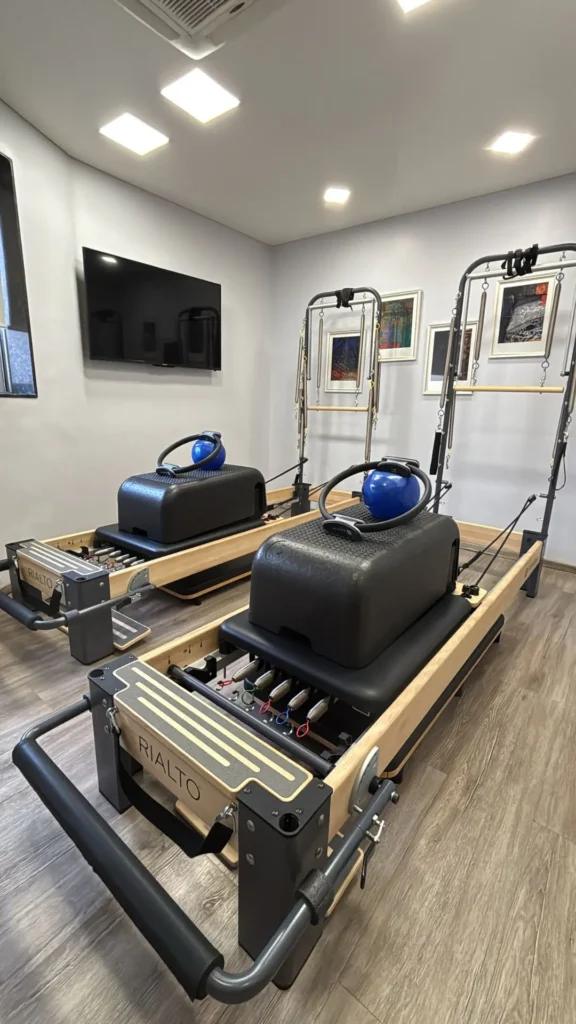
Difference Between Mat and Reformer Pilates
One of the most important differences lies in spinal support. Many mat exercises require lifting the head, neck, and limbs against gravity, which can strain the spine if core strength is insufficient. Reformer Pilates supports the body throughout movement, encouraging neutral spinal alignment. For individuals seeking Pilates for back pain, this support is critical. Controlled resistance allows strengthening without unnecessary compression or strain.
Spinal Support, Posture, and Back Pain Considerations
Posture correction is another area where Reformer Pilates offers a clear advantage. Poor posture among Mumbai’s professionals is driven by prolonged sitting, screen use, and stress. It strengthens deep stabilising muscles while reinforcing correct alignment through repetitive, precise movements. Pilates for posture becomes more intuitive because the machine provides constant feedback like misalignment is felt immediately, allowing quicker correction.
Progression is also more structured with Reformer Pilates. Springs provide variable resistance, enabling continuous challenge without increasing impact. This makes Reformer Pilates ideal for Pilates for working professionals who want steady improvement without excessive soreness or injury risk. Mat Pilates progression, while possible, often plateaus sooner due to limited resistance options.
For professionals dealing with recurring discomfort, Pilates for back pain is often a deciding factor. It allows exercises to be performed in supported positions, reducing stress on sensitive areas while building strength. This makes it particularly effective for chronic low back pain and postural imbalances. Mat Pilates can also help with precise technique and careful supervision to avoid aggravating symptoms.
Time efficiency is another major consideration. Reformer Pilates sessions are typically highly structured and instructor-led, ensuring that every minute is purposeful. Boutique Pilates classes in Mumbai often use reformer sessions to integrate strength, mobility, and flexibility into a single workout. For professionals balancing work and personal commitments, this efficiency is invaluable.
That said, mat Pilates still has its place. It is accessible and effective for developing control and awareness. For individuals with strong foundations and no physical limitations, mat Pilates can complement reformer training. However, when choosing one primary modality, Reformer Pilates offers greater versatility and support.
Reformer Pilates also plays a significant role in injury prevention. By improving joint stability and muscle balance, it reduces compensatory movement patterns that commonly lead to pain. This is particularly relevant for Pilates for back pain and posture-related issues common among desk-bound professionals.
Choosing the Right Pilates Approach for Long-Term Results
The growing demand for Pilates classes in Mumbai reflects a shift toward personalised, intelligent fitness. Reformer Pilates fits seamlessly into this landscape, offering small group formats, individual attention, and tailored resistance. For Pilates for working professionals, this personalised approach supports long-term consistency. Ultimately, the choice between mat and reformer Pilates depends on individual needs. Mat Pilates may suit those seeking simplicity and minimal equipment. But for professionals managing back pain, posture issues, and time constraints, Reformer Pilates provides a more comprehensive solution.
In a city as demanding as Mumbai, fitness must work with the body, not against it. Reformer Pilates delivers strength, support, and progression in a way that aligns with modern professional life. For many working professionals, it is not just the better option but it is the smarter one.
Journal References
- Fernández-Rodríguez R et al. Pilates-based exercise and chronic low back pain. Journal of Orthopaedic & Sports Physical Therapy, 2022.
- Gholamalishahi S et al. Pilates interventions for low back pain: Umbrella review. 2022.
- Li F et al. Effects of Pilates on posture and spinal alignment. Systematic review, 2024.
- Ko HS et al. Neuromuscular activation differences in mat vs reformer Pilates. Frontiers in Physiology, 2024.
- Cruz-Díaz D et al. Core stability and functional outcomes in Pilates training. Journal of Back and Musculoskeletal Rehabilitation, 2018.
To know about the reviews of the customers – Click Here